Model vs. Render: Why a Screen Is No Longer Enough for the Discerning Investor

In a saturated digital market, physical 3D models distinguish projects from 'too perfect' renders. They create tangible confidence, activate spatial insight, and stimulate dialogue in the boardroom. This makes the model an indispensable tool for the final investment decision.

Model vs. Render: Why a Screen Is No Longer Enough for the Discerning Investor

Walk into any property development sales office in 2026 and you’ll be surrounded by screens. Photorealistic renders, VR tours and 360-degree videos have become the norm. But this presents a problem: because everyone is doing it, it loses its distinctive edge. For the discerning investor, who sees dozens of projects pass by every day, a render is often ‘too perfect to be true’.

At 3D Maquettes, we’ve noticed that the market is becoming saturated with digital images. To truly convince, a return to tangible reality is needed. This is why 3D renderings alone are no longer enough.

1. Breaking through ‘render fatigue’

A render is a carefully staged image. The architect chooses the best angle, the most flattering lighting and the most ideal setting. Investors know this. They are trained to see through the ‘marketing layer’.

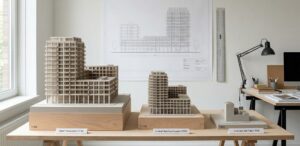
A physical model breaks through this digital noise. It is an object that occupies space, casts shadows and can be viewed from any angle. Whilst a render is a promise, a model feels like proof.

2. The psychology of trust and transparency

When an investor looks at a screen, the creator decides what is visible. When an investor walks around a model, they decide that for themselves.

  • Does the investor want to know how the rear of the building connects to the logistics zone?
  • Is there any doubt about the scale of the atrium in relation to the façade?

By simply bending down or walking around the model, the investor gets an immediate answer. This transparency builds trust that simply cannot be matched by a series of static images.

3. Spatial intelligence: our brains in 3D

Our brains have evolved to understand physical objects in three-dimensional space. Although 3D software simulates depth on a screen, it remains a two-dimensional projection.

With a physical model, our ‘spatial intelligence’ is fully activated. We understand mass, volume and proportions immediately on an instinctive level. For an investor, this means they not only ‘see’ the project, but also ‘feel’ it. That feeling is often the deciding factor in a multi-million-pound investment.

4. The model as a ‘Social Hub’ in the boardroom

Sales meetings do not take place in a vacuum; they are social interactions. A presentation on a tablet or screen is often an individual experience. A model, on the other hand, acts as a campfire.

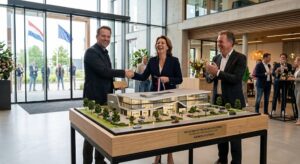
Stakeholders, architects and investors stand together around the model. They point, discuss and visualise on the spot. It promotes dialogue and speeds up decision-making because everyone is literally and figuratively on the same page (facing the model).

The hybrid strategy: The best of both worlds

Does this mean that renders are superfluous? Certainly not. A render is fantastic for online marketing and conveying atmosphere. However, for the closing phase of a deal – the moment when the critical questions are asked and the contract must be signed – the model is unbeatable.

At 3D Maquettes, we often recommend a hybrid approach:

  • Use renders for initial online attention and brochures.
  • Use a high-quality 3D-printed model for physical meetings and the final sale.

Make the impact tangible

Investors in 2026 are looking for certainty and tangibility. Give them the chance not only to view your vision, but also to experience it.

Do you have a major project in the pipeline and want to boost the persuasiveness of your presentation? Contact 3D Maquettes. We’ll help you turn your digital design into an irresistible physical sales tool.

LinkedIn
Facebook
Meer blogs

3D ontruimingsplannen: Waarom een maquette levens kan redden

In noodsituaties is abstract denken lastig. Een fysieke 3D-maquette biedt instinctief ruimtelijk inzicht in vluchtwegen en risicozones. Dit tastbare hulpmiddel trapt personeel preventief en ondersteunt hulpdiensten cruciaal bij een crisis, wat de algemene veiligheidscultuur en zorgplicht versterkt.

Bekijk blog »

Also interesting, check out other blogs

3D ontruimingsplannen: Waarom een maquette levens kan redden

In noodsituaties is abstract denken lastig. Een fysieke 3D-maquette biedt instinctief ruimtelijk inzicht in vluchtwegen en risicozones. Dit tastbare hulpmiddel trapt personeel preventief en ondersteunt hulpdiensten cruciaal bij een crisis, wat de algemene veiligheidscultuur en zorgplicht versterkt.

Bekijk blog »