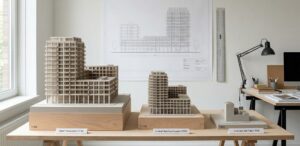
How big should my scale model be? Tips for choosing the right scale

Too small and details disappear; too large and it fits nowhere. The right scale determines the success of every model. Discover which factors influence the choice and which scales best suit your project and intended use.

How big should my scale model be? Tips for choosing the right scale

One of the first questions that comes up when commissioning a scale model is also one of the most practical: how big should it be? The answer may seem straightforward, but it goes to the heart of what makes a scale model successful. Too small and the details get lost. Too large and the model no longer fits anywhere and becomes unmanageable. The right scale is the balance between level of detail, intended use, and available space.

In this article, we explain how to choose the right scale and which rules of thumb will help you get there.

What exactly is scale?

Scale is the ratio between the dimensions of the model and reality. A scale of 1:100 means that one centimetre on the model corresponds to one hundred centimetres — one metre — in reality. The smaller the number after the colon, the larger the model relative to the original.

A building 20 metres wide becomes 20 centimetres wide on a 1:100 model. At 1:200, that same building is only 10 centimetres wide. That simple calculation quickly determines whether a model fits on a meeting table or requires an entire podium.

Step 1: determine the intended use

The scale depends first and foremost on what the model will be used for. Different applications call for different ratios.

A presentation model for investors or clients needs to impress and show detail. Scales between 1:50 and 1:200 are common here, depending on the size of the project.

An urban planning model of a neighbourhood, business district, or municipality covers a much larger area. A scale of 1:500 or even 1:1000 is often chosen — otherwise the model simply won’t fit through the door.

A technical model of a machine or installation calls for larger scales such as 1:10 or 1:20, so that the workings and components are clearly visible.

A historical or heritage model for a museum is often made as large as the available space allows, to impress visitors and show details that would otherwise remain invisible.

Step 2: consider the available space

A model that doesn’t fit anywhere is a problem. Determine in advance where the model will be placed: on a table in a meeting room, on a plinth in an entrance hall, in a display case, or at a trade fair where it needs to be moved and transported.

Measure that space and work backwards. If the table is 120 by 80 centimetres and the project covers an area of 300 by 200 metres in reality, a scale of 1:500 fits neatly — at 1:200 the model would extend beyond the edges on all sides.

Don’t forget the height either. Taller buildings or installations can become impractically tall at a larger scale, making them awkward to handle or difficult to transport.

Step 3: balance detail level against scale

The larger the scale (i.e. the smaller the number after the colon), the more detail is visible. At 1:50, window frames, balconies, and facade details are clearly distinguishable. At 1:500, those same details are barely visible and what matters most is the massing and spatial composition.

This is not a problem — it is a choice. An urban planning model does not need to show individual windows. An architectural model for a sales office does. Determine which details are essential to the message the model needs to convey, and choose the scale that makes those details visible.

Common scales at a glance

As a reference, these are the most widely used scales by application:

1:20 – 1:50 — detail-rich technical or interior models, small buildings or components where the workings or finish are central.

1:100 – 1:200 — the most commonly used scales for architectural and presentation models of individual buildings or complexes.

1:500 – 1:1000 — urban planning and area models where overview is more important than detail.

1:2000 and smaller — large infrastructure projects, landscape models, or overview maps in model form.

No universal answer, but a good conversation

There is no universally correct scale. What works for a ten-storey apartment building does not work for an industrial site covering ten hectares. That is why every project at 3D Maquettes starts with a conversation: what do you want to show, where will the model be placed, and what is the budget?

Based on those three questions, we always advise a scale that suits the purpose — not so small that it fails to impress, and not so large that it becomes impractical.

Want to know more or request a quote?

Unsure about the right scale for your project? Feel free to get in touch. We are happy to think along with you at no obligation and advise based on your specific situation. Request a quote at https://3dmaquettes.nl/en/request-a-qoute/

LinkedIn
Facebook
More blogs

You might also be interested in these other blogs