From investment to heritage: How to keep a model in top condition for years to come

Preserve the quality of your model through optimal environmental factors, proper handling, and safe cleaning. Discover how to protect specific materials such as PLA and PETG against UV radiation, heat, and dust, ensuring your investment remains a showcase for years to come.

From investment to heritage: How to keep a model in top condition for years to come

Whether your model is made from PLA or PETG, each material has specific properties that require the right care. When a model is displayed in an open space, there are three main factors to bear in mind: environment, handling and cleaning.

The ideal environment: sunlight and heat

Although our materials are of industrial quality, they remain sensitive to extreme environmental factors.

  • UV radiation: Direct sunlight can cause colours to fade over time. Try to place the model in a spot where it is not exposed to direct, bright sunlight. This is particularly true for white PLA, which can yellow over time due to excessive UV radiation.
  • Heat sources: Never place a model directly above an active radiator. With PLA in particular, constant heat can cause fine details to warp slightly over time. A stable room temperature is ideal for maintaining dimensional stability.

Touch: the ‘look with your eyes’ rule

It is tempting for customers or passers-by to briefly stroke the model or point out details.

  • Skin oils: Our fingers leave behind acids and oils without us noticing. This dirt can accumulate in the fine texture of a 3D print.
  • Fragile details: Lampposts, tree trunks or thin balustrades are extremely fragile at scale. Instruct users to use a pen or pointer (without touching the model) when pointing to prevent accidental breakage.

Cleaning without damage

Dust is the greatest enemy of an open-air model. Because 3D prints often have a light texture, dust easily gets ‘caught’ in them.

  • Compressed air: Use a can of compressed air (such as that used for computer parts) to blow dust out of deep crevices and corners. Do this from a suitable distance to prevent the air pressure from becoming too high for small parts.
  • The soft brush: For surface dust, a very soft, clean make-up brush or a sable brush is ideal. Use this to gently sweep over the roofs and streets without leaving scratches.
  • Exception for moisture: Never use water or soap on PLA and PETG; this forms a dull film.

Specific maintenance per material

  • PLA: This is a biodegradable plastic. It is very stable but does not fare well in damp environments. A dry office environment is perfect.
  • PETG: The most robust choice for technical models. This material is more resistant to heat and impact, but can sometimes attract dust more quickly due to static electricity. An anti-static spray (on a cloth, not directly on the print) can help with this for the base.

Want to have your model restored?

Do you have a project that has lost its lustre due to damage or the passage of time? Send us a photo of the model’s current condition. We will assess the damage and give you honest advice on the restoration options, so that your model can once again serve as a showcase for years to come.

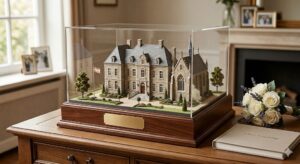
Tip: Would you like to protect your model permanently against dust and handling? Then ask us about the options for a bespoke plexiglass dust cover. We can supply these on request, tailored to the dimensions of your specific model.

Do you have any questions about the best place for your new model? Please feel free to contact us. We’d be happy to advise you on the best way to keep your project looking its best for years to come.

LinkedIn
Facebook
More blogs

3D evacuation plans: Why a model can save lives

3D evacuation plans: Why a model can save lives The human brain is programmed to think in three dimensions. In a calm environment, most people have no trouble translating a flat drawing into reality. However, as soon as panic or time pressure sets in, our capacity for abstract thinking diminishes.

View blog »

Also interesting, check out other blogs

3D evacuation plans: Why a model can save lives

3D evacuation plans: Why a model can save lives The human brain is programmed to think in three dimensions. In a calm environment, most people have no trouble translating a flat drawing into reality. However, as soon as panic or time pressure sets in, our capacity for abstract thinking diminishes.

View blog »